
Cross the border.
Skip the surprise.
Othermile checks every online order for duty, tax and carrier fees between Canada and the US, before it is printed or shipped. It is our own product, designed, built and run by us, and it is live at othermile.com.
It started with one shirt.
A store charged $9.99 for shipping. The printer in the US charged $21.39 for the label. The customer in Alberta then paid another $18.32 at the door. Nobody did anything wrong. The costs were simply invisible until the order was gone, and the cheapest fix, sending the same shirt by courier, would have cost the customer nothing at all.
That is the whole product in one order. A flat shipping rate, a printer in one country, a blank sewn in another and two governments that change their rules every few weeks: none of it is hidden on purpose, and all of it lands on the person who opens the box.
The whole site,
at your own pace.
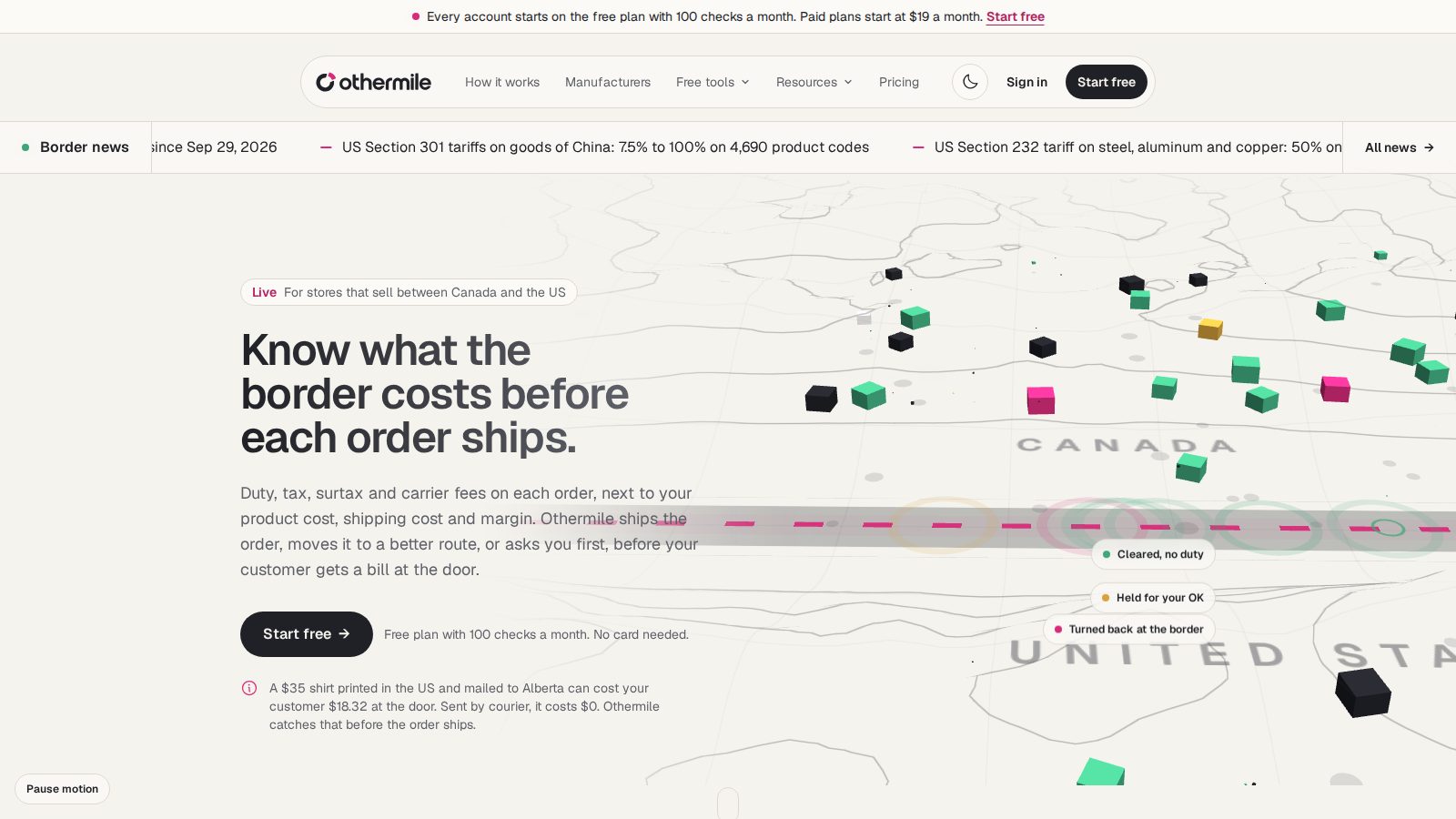
One promise above the fold, then the argument for it in the order a store owner asks: who it is for, what goes wrong, what happens to an order, what it connects to, where the numbers come from and what it costs. A live border-news ticker sits under the bar, because the rules really do move that often.
Visit Othermile ↗
Captured from the live site at full height, so you read it the way a store owner scrolls it rather than as a thumbnail.
The work
Product design, the order-check engine, the border-rules pipeline, the web app, the public site, the API, the SDK and the MCP server.
The environment
Official US and Canadian tariff data read every morning, hosted in Canada, connected to the stores, printers and warehouses that orders actually move through.
The learning
A border tool that guesses is worse than none. Every rate comes from the government that set it, and anything unusual waits for a person.
Four answers, before anything is printed.
Every order can go out more than one way: the printer's usual facility, a backup printer, mail or courier. Each has its own cost, its own border charge and its own delivery time. Othermile prices all of them, applies the limits the owner set once, and gives the order one of four outcomes.
- Released
- Inside the owner's limits. It goes ahead on its own, and nobody has to look at it.
- Switched
- A better route is inside the limits, so it takes that one. In the shirt above, the switch to a Canadian printer keeps $11.14 more and the customer pays nothing at the door.
- Held
- It needs the owner. It waits, and their phone shows every option priced side by side. Approving takes a passkey, so nobody can approve on their behalf.
- Blocked
- It cannot go at all, for example because the product is banned at the border that week.
Each decision is kept in a signed record of what was known at the time, so an owner can show later why an order went the way it did, and nobody can quietly change it.
Customs, for people who have never met a broker.
The rules are public. The difficulty is that they are written for customs brokers, and the people paying them are often running a print-on-demand shop on their own. Most of the design work was translation: turning a tariff schedule, a surtax order and an exchange rate into one sentence an owner can act on, such as "this order costs your customer $18.32 at the door; by courier it costs nothing."
The second half was deciding who decides. Othermile never quietly changes what a store does. The owner sets their limits once, in plain terms: the most they will lose on shipping, the lowest margin they accept, the most a customer may pay at the door. Inside those limits it gets on with it. Outside them it stops and asks, on the phone, in seconds. We would rather hold an order and ask than guess.
It also has to fail safely. If Othermile is ever unreachable, printer orders stay on hold rather than printing unchecked, and store orders are checked as soon as it is back.
One engine. Four kinds of people at the border.
Online stores
Every order checked before it prints or ships, against the owner's own limits. Shopify, WooCommerce, BigCommerce, Squarespace, Wix, Square and Ecwid connect directly, as do Printify, Printful, Gelato, Prodigi, Gooten, ShipStation, ShipMonk, ShipHero and ShipBob.
Manufacturers and importers
Upload a product list and see a year of duties, tariffs and surtaxes, product by product, with a first look at which products could qualify for CUSMA and what a proposed change would do. Othermile shows the numbers; a licensed customs broker does the filing.
Shoppers
A free checker that says what a parcel will cost at the door before you order it from across the border. No account, no sign-up.
Developers and AI agents
The same engine through a REST API, an npm SDK and a hosted MCP server, so an AI assistant can quote a border cost from the rules in force instead of guessing one.
Useful before anyone signs up.
A product that asks for a credit card before it has shown you anything has not earned one. So a good part of Othermile is free and open, and every piece of it runs on the same rules the paid product uses.
- Shopper checker
- Price one parcel by mail and by courier, to any province or territory, in seconds.
- Tariff tracker
- What an order of each product owes at the border, followed over time like a price, with every tariff that started, ended or changed marked on the line.
- Border cost audit
- Read a store's order export and show what its customers paid at the door. The file stays in the browser; names and addresses never leave it.
- Tariff alerts
- One email when the border cost of a product changes, and silence the rest of the time.
- Duty guides
- Duty, tax and fees for nine common products, in both directions, in plain language.
ClutchCloth runs every order through it.
ClutchCloth, our automotive apparel brand, is printed on demand and shipped to customers on both sides of the border, which makes it exactly the store Othermile was built for. Its Printify store is connected, every order waits for an OK before it goes to production, and the shirt arrives without a bill at the door.
That is the arrangement we prefer for anything we sell: we use it on our own money first. The full walkthrough is on the Othermile blog.
No guesses from a chatbot.
Rates, lists and dates come from the governments that set them: the US tariff schedule and its tariff orders, Canada's customs tariff and its surtax orders, and the Bank of Canada exchange rate. Each update is checked before it reaches anyone's orders, and anything unusual waits for a person to approve it. Data stays in Canada, is never sold, and is never used to train AI models.
Othermile gives estimates from official rules. It is not a customs broker and not customs advice, and it says so plainly. Being clear about where a tool stops is part of designing it.
A hard problem nobody
has built for yet?
Othermile is a whole product: an engine, an app, an API and a public site, built and run by us. Tell us about the problem in your business that a spreadsheet keeps losing.